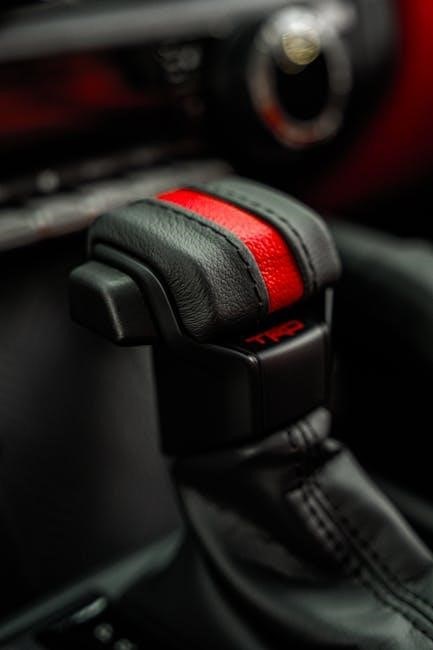
4×4 manual transmission
4×4 manual transmissions offer robust control and precision for off-road adventures, blending driver engagement with the capability to tackle diverse terrains effectively.
What is a 4×4 Manual Transmission?
A 4×4 manual transmission system combines a traditional manual gearbox with a transfer case, enabling power delivery to all four wheels. Unlike 2WD manuals, it allows drivers to select between two-wheel drive and four-wheel drive modes. The transfer case is crucial, shifting power between axles, and often features on-the-fly adjustment. This setup provides enhanced traction and control, particularly vital for navigating challenging off-road conditions, offering a direct connection between driver and vehicle.
Why Choose a Manual Transmission for Off-Roading?
Manual transmissions grant superior control and precision during off-road driving, allowing drivers to maintain engine braking and select optimal gears for challenging terrain. This direct connection enhances responsiveness, crucial for navigating obstacles. While automatics offer convenience, manuals prevent unwanted gear changes, providing consistent power delivery and maximizing control in demanding situations, appealing to enthusiasts seeking a more engaged driving experience.
Key Components of a 4×4 Manual System
A 4×4 manual system fundamentally comprises the manual transmission, a transfer case for power distribution, and robust driveshafts/axles delivering torque to all wheels.
The Manual Transmission Itself
The manual transmission is the core of the system, utilizing gears to adjust engine output for varying speeds and terrain. Popular choices like the NV3500, NV4500, and SM465 are known for durability and adaptability. These transmissions often require adapter plates for compatibility with different engines, notably LSx swaps, and specific tailhousings are crucial for 4×4 applications. Selecting the right transmission depends on engine power and intended vehicle use, ensuring reliable performance and a satisfying driving experience.
The Transfer Case: Power Distribution
The transfer case is pivotal, distributing power between the front and rear axles, enabling both 2WD and 4WD operation. Crucially, it can often be adjusted “on-the-fly,” shifting between drive modes as needed. This “splitter box” manages power delivery, and the Vehicle Speed Sensor (VSS) is frequently located within the transfer case itself, vital for accurate speed readings in 4×4 systems.
Driveshafts and Axles: Delivering the Power
Driveshafts transmit rotational force from the transfer case to the front and rear axles, while robust axles then deliver power directly to the wheels. These components must withstand significant stress during off-road use. Compatibility with specific transmissions – like the NV3500, NV4500, or SM465 – often dictates the need for appropriate tailhousings and adapter plates for proper alignment and function.

Popular 4×4 Manual Transmission Options
Popular choices include the NV3500, NV4500, and SM465, known for reliability and adaptability with various engine and transfer case combinations, aided by aftermarket support.
NV3500: A Common Choice
The NV3500 stands as a frequently selected transmission due to its widespread availability and relatively affordable price point. It’s a solid option for many 4×4 builds, particularly those not demanding extreme horsepower or heavy-duty usage. Aftermarket support is plentiful, offering adapter plates for diverse engine swaps, including LSx platforms. While not the strongest, its simplicity and cost-effectiveness make it a practical choice for many off-road enthusiasts seeking a reliable manual transmission solution, especially when paired with appropriate gearing and a robust transfer case.
NV4500: Heavy-Duty Capabilities
The NV4500 distinguishes itself as a heavy-duty transmission, capable of handling significant power and torque – ideal for larger engines and demanding off-road applications. Its robust construction ensures durability, making it a favorite for those undertaking LSx engine swaps or building high-performance 4x4s. While generally more expensive than the NV3500, the NV4500’s strength and reliability justify the investment for serious off-roaders needing a transmission that can withstand considerable stress and abuse.
SM465: Classic and Durable
The SM465 represents a classic, incredibly durable option, often found in older trucks and known for its simple, robust design. It’s a four-speed manual transmission celebrated for its longevity and ability to withstand harsh conditions. While lacking the overdrive gear of newer transmissions, the SM465 remains a popular choice for those prioritizing simplicity and reliability in their 4×4 builds, supported by readily available aftermarket adapters.

Adapting Transmissions for 4×4 Applications
Adapting transmissions often requires adapter plates and careful consideration of tailhousing compatibility to ensure proper fitment with the transfer case for 4×4 systems.
Adapter Plates and Compatibility
Adapter plates are crucial when mating a transmission to a different engine or transfer case. Numerous aftermarket specialists fabricate these plates, expanding compatibility for popular transmissions like the NV3500, NV4500, and SM465. Ensuring correct bolt patterns and proper alignment is paramount for a successful installation. Careful research is needed to verify compatibility between the chosen transmission, engine, and transfer case, as not all combinations are directly supported without modification or specialized adapters.
Tailhousing Considerations for 4×4
Tailhousing selection is vital for 4×4 applications, as it dictates transfer case compatibility. Some transmissions require specific tailhousings designed for 4WD, while others utilize adapters. The H3’s manual transmission, for example, could potentially handle an LSx swap alongside a transfer case. Ensuring the correct tailhousing or adapter aligns properly with the transfer case input shaft is crucial for a functional and reliable drivetrain setup, avoiding alignment issues and potential damage.
Speed Sensors in 4×4 Manual Transmissions
Vehicle Speed Sensors (VSS) are often located within the transfer case on 4WD systems, providing crucial speed data for various vehicle functions and diagnostics.
Location of the Vehicle Speed Sensor (VSS)
Determining the VSS location is critical during manual transmission swaps or troubleshooting. In 4×4 vehicles, unlike some 2WD models, the VSS is frequently mounted directly within the transfer case itself. This placement allows it to accurately measure wheel speed considering power distribution to all four wheels. Identifying the sensor’s exact position requires consulting vehicle-specific repair manuals, as variations exist between manufacturers and models. Proper connection and calibration are essential for accurate speedometer readings and optimal transmission control system function.
VSS in the Transfer Case
Locating the VSS within the transfer case presents unique considerations. Because it monitors speed after power splits to both axles, it provides a comprehensive reading for 4×4 systems. Accessing the sensor often requires partial transfer case disassembly. Ensuring correct alignment and sealing during reinstallation is vital to prevent leaks or inaccurate signals. The VSS interacts directly with the vehicle’s computer, influencing shift patterns and speedometer functionality, making its proper operation paramount for reliable performance.

Manual vs. Automatic for Off-Roading
Manual transmissions deliver superior control and precision off-road, while automatics offer convenience. The choice depends on driver preference and terrain demands.
Control and Precision of Manuals
Manual transmissions grant drivers exceptional control, crucial for navigating challenging off-road obstacles. This direct connection allows precise gear selection, optimizing torque and engine braking for varied terrain. Unlike automatics, manuals eliminate torque converter slip, providing immediate power delivery.
This heightened responsiveness is invaluable when rock crawling or traversing steep inclines, fostering a more connected and confident driving experience. The ability to hold gears is a significant advantage.
Automatic Transmission Advantages
Automatic transmissions simplify operation, reducing driver fatigue during prolonged off-road excursions. They offer smooth gear changes, beneficial for maintaining momentum across uneven surfaces. Modern automatics often feature lock-up torque converters, minimizing power loss and improving efficiency.
For some, the ease of use outweighs the control offered by a manual, particularly in demanding conditions where constant shifting could be cumbersome or distracting.
Low Range Gearing and Crawl Ratios
Low range gearing is crucial for off-roading, providing increased torque for navigating obstacles, while crawl ratios determine slow, controlled movement over challenging terrain.
Importance of Low Range for Off-Roading
Low range gearing dramatically increases torque multiplication, essential when confronting steep inclines, rocky trails, or deep mud. This allows a 4×4 manual transmission to overcome significant resistance with controlled power. Without low range, the engine would struggle or stall, lacking the necessary leverage. It enables precise throttle control, preventing wheel spin and maximizing traction. Effectively, low range transforms a vehicle into a methodical, obstacle-conquering machine, enhancing both capability and driver confidence on demanding off-road courses.
Calculating Crawl Ratios
Crawl ratio, a key metric for off-road performance, determines how slowly a vehicle can move relative to engine speed. It’s calculated by multiplying the transmission’s low gear ratio, the transfer case’s low range ratio, and the axle gear ratio. A higher crawl ratio equates to slower, more controlled movement over obstacles. Understanding this calculation allows enthusiasts to optimize gearing for specific terrains, maximizing control and minimizing the need for excessive throttle input during challenging crawls.

Maintenance and Reliability
Regular maintenance—fluid checks, clutch inspection—is crucial for 4×4 manual transmissions. Addressing issues promptly ensures longevity and dependable performance on and off the trail.
Regular Maintenance Schedule
Consistent upkeep is vital for a reliable 4×4 manual transmission. Every 30,000 miles, inspect the clutch for wear and ensure proper fluid levels in both the transmission and transfer case. Change transmission fluid every 30,000-60,000 miles, depending on usage. Regularly check driveshaft U-joints and axles for play or damage. Inspect shift linkages for smooth operation, and address any unusual noises promptly to prevent escalating issues and maintain optimal performance.
Common Issues and Troubleshooting
Typical problems include clutch failure – indicated by slipping or difficulty shifting – and internal transmission wear causing grinding noises. Shifting difficulties often stem from worn synchronizers or linkage adjustments. Transfer case issues may present as noises in 4WD. Inspect the Vehicle Speed Sensor (VSS) if experiencing erratic behavior. Address leaks promptly, and always diagnose unusual sounds to prevent further damage and costly repairs.

LSx Engine Swaps and Manual Transmissions
LSx swaps pair well with NV3500, NV4500, and SM465 transmissions, requiring adapter plates and careful consideration of the transfer case for 4×4 functionality.
Compatibility with LSx Engines
LSx engine swaps demonstrate excellent compatibility with several manual transmissions, notably the NV3500, NV4500, SM465, TH350, and TH400. Successful integration often necessitates adapter plates to ensure proper alignment between the engine and transmission. Furthermore, selecting a 4×4-compatible tailhousing or utilizing available adapters is crucial for connecting to the transfer case, enabling four-wheel drive functionality. These combinations offer a potent and reliable drivetrain for off-road vehicles.
Transfer Case Considerations for Swaps
When performing an LSx engine swap with a manual transmission, careful transfer case selection is paramount. Compatibility hinges on the transmission’s output shaft spline count and the transfer case’s input spline. Adapters may be required for proper fitment. Consider the transfer case’s gear ratios to complement the transmission and vehicle’s intended use, ensuring optimal crawling and overall performance. Thorough research is vital for a seamless integration.

Aftermarket Support and Upgrades
Aftermarket specialists provide upgrades for strength and performance, including adapter plates, enhancing 4×4 manual transmissions for demanding applications and engine swaps;
Available Upgrades for Strength and Performance
Numerous upgrades bolster 4×4 manual transmissions. These include heavy-duty clutches for increased torque handling, reinforced shift forks to prevent bending, and upgraded synchronizers for smoother gear changes. Stronger input shafts and output shafts enhance durability, while aftermarket gear sets offer different ratios for optimized crawling or highway speeds. Furthermore, robust case savers protect against catastrophic failures, and improved seals minimize leaks, ensuring long-lasting performance on challenging trails.
Aftermarket Specialists and Adapter Options
Several specialists facilitate 4×4 manual swaps and upgrades. Companies offer adapter plates to mate transmissions to various engines, like LSx platforms, and create custom solutions. Tailhousing adapters ensure proper fitment with different transfer cases. These specialists provide valuable expertise and components, simplifying complex installations. Resources like 4x4Review highlight popular transmission choices and supporting vendors, aiding enthusiasts in building reliable and capable off-road drivetrains.
The Transfer Case: On-the-Fly Adjustment
Transfer cases enable seamless shifting between 2WD and 4WD, even during operation, providing adaptable traction for varying conditions and terrain challenges.
Shifting Between 2WD and 4WD
Shifting between 2WD and 4WD is a core function of the transfer case, allowing drivers to adapt to changing road conditions. Many systems offer “on-the-fly” shifting, meaning it can be done while moving at lower speeds. Engaging 4WD distributes power to all four wheels, enhancing traction on slippery surfaces like snow, mud, or gravel. Disengaging returns the vehicle to 2WD for improved fuel efficiency and reduced wear on components during normal driving.
Transfer Case Mechanisms
Transfer case mechanisms vary, but commonly involve a chain-driven or gear-driven system to split power. A shift fork, controlled by a lever or electronic actuator, engages different gear sets. These sets dictate the power distribution – 2WD, 4WD High, or 4WD Low. Some cases utilize a viscous coupling or clutch pack for automatic torque distribution, enhancing stability and traction. Regular inspection and fluid changes are crucial for optimal function.

Transmission Selection Based on Engine and Vehicle
Careful matching of the transmission to engine power and vehicle weight is vital, considering terrain demands for optimal performance and durability in 4×4 applications.
Matching Transmission to Engine Power
Selecting the right transmission hinges on harmonizing it with the engine’s output. Higher horsepower LSx engines, for instance, demand robust options like the NV4500 or even a TH400 with an adapter. Conversely, lower-powered engines can effectively utilize the NV3500.
Consider torque curves; a transmission’s gear ratios must complement the engine’s powerband to maximize efficiency and capability, especially during challenging off-road scenarios.
Vehicle Weight and Terrain Considerations
Heavier vehicles and demanding terrain necessitate transmissions with greater strength and lower gearing. A larger, heavier rig benefits from the NV4500’s durability and wider gear spread. For rocky trails, prioritize low-range gearing and crawl ratios. Lighter vehicles can often suffice with the NV3500, but always factor in anticipated loads and the severity of the off-road challenges you’ll encounter.

Troubleshooting Common 4×4 Manual Transmission Problems
Common issues include clutch failures and shifting difficulties; diagnosing these requires careful inspection of components and addressing underlying causes promptly for reliable operation.
Clutch Issues
Clutch problems frequently manifest as slipping, difficulty engaging gears, or a spongy pedal feel within 4×4 manual systems. Worn clutch discs, a failing pressure plate, or a hydraulic system leak are typical culprits. Thoroughly inspect the clutch linkage, master and slave cylinders, and the disc itself for signs of wear or damage. Addressing these issues promptly prevents further transmission damage and ensures consistent power transfer during demanding off-road conditions.
Shifting Difficulties
Shifting problems in a 4×4 manual transmission can range from grinding gears to complete inability to select a gear. Potential causes include a worn synchronizer, bent shift forks, or low/contaminated transmission fluid. Inspect the shift linkage for proper adjustment and ensure the clutch is fully disengaging. Addressing these issues promptly is crucial for maintaining control and preventing internal transmission damage, especially during challenging terrain navigation.

The Future of 4×4 Manual Transmissions
4×4 manuals retain relevance in off-roading, offering a direct connection and control; potential advancements may integrate technology while preserving the core driving experience.
Continued Relevance in Off-Roading
Despite the rise of automatics, the 4×4 manual transmission maintains a strong foothold within the off-road community. Enthusiasts value the unparalleled control and direct mechanical connection it provides, crucial for navigating challenging trails. This direct link allows for precise engine braking and gear selection, enhancing maneuverability over varied terrain.
Furthermore, the simplicity of a manual system can be advantageous in remote locations where complex electronic systems might fail, ensuring continued operation and reliability when it matters most.
Potential Technological Advancements
While fundamentally mechanical, 4×4 manual transmissions aren’t immune to innovation. Future advancements might include improved shift assist systems, offering smoother and quicker gear changes without compromising driver control. Enhanced materials could increase durability and reduce weight, boosting performance.
Integration with modern engine management systems, alongside refined clutch technologies, could optimize power delivery and fuel efficiency, maintaining the manual’s appeal in a technologically evolving landscape.


Leave a Reply
You must be logged in to post a comment.