boss katana 50 mk2 manual
The BOSS Katana 50 MkII is a versatile guitar amplifier, covered in comprehensive manuals available in multiple languages. It caters to diverse players.
What is the BOSS Katana 50 MkII?
The BOSS Katana 50 MkII is a highly acclaimed, modeling guitar amplifier renowned for its exceptional tone and versatility. This amplifier faithfully recreates a wide spectrum of iconic amplifier sounds, from pristine clean tones to high-gain distortion. It’s designed for guitarists seeking a flexible and powerful amplification solution. The Katana series, including the 50 MkII, boasts user-friendly operation alongside deep customization options via the BOSS Tone Studio editor.
Manuals are available in English, German, French, Italian, Spanish, Portuguese, Dutch, and Simplified Chinese.
Key Features and Improvements over Previous Models
The Katana 50 MkII builds upon its predecessor with significant enhancements. Improved amp models deliver even more authentic and nuanced tones. Expanded effects options, including a new Booster effect akin to the BOSS BD-2, provide greater sonic flexibility. The upgraded version features enhanced connectivity and control via the BOSS Tone Studio editor.
Physical improvements include folding legs for portability, with one leg for the 50 and two for the 100/212 models. Manuals detail these features.
Target Audience: Who is this Amplifier For?
The BOSS Katana 50 MkII is designed for a broad spectrum of guitarists. It suits beginners seeking a versatile practice amp and experienced players needing a reliable stage or studio tool. Its diverse amp models and effects cater to various genres, from blues and rock to metal and more.
The availability of manuals in multiple languages broadens its appeal to a global audience, making it accessible to players worldwide.
Unboxing and Initial Setup
The Katana 50 MkII includes a user manual and power cord. Ensure the folding stand is securely deployed before use, especially for larger models.
Package Contents: What’s in the Box?
Upon unboxing your BOSS Katana 50 MkII, you’ll find the amplifier unit itself, accompanied by a detailed owner’s manual to guide you through its features. A power cord is included for immediate operation. Importantly, the Katana-50 MkII features a single folding leg attached to its base, designed for stability during performance. Larger models, like the Katana-100/212, include two folding legs – one on each side – for enhanced support. Remember to properly unfold and secure these legs before transporting or using the amplifier to prevent damage or instability.
Connecting the Amplifier: Inputs and Outputs
The BOSS Katana 50 MkII offers standard input jacks for your guitar, alongside various output options for connectivity. Locate the input jack on the amplifier’s front panel to connect your instrument cable. For external connections, utilize the rear panel’s outputs, including a line out for recording or connection to a mixing console. A headphone output is also available for silent practice. Ensure all cables are securely connected to prevent signal loss or unwanted noise during operation. Proper connections are crucial for optimal sound quality.
Powering On and Basic Operation
To power on the BOSS Katana 50 MkII, locate the power switch, typically found on the rear panel. Ensure the amplifier is connected to a suitable power source before switching it on. Once powered, the control panel illuminates, displaying the current settings. Begin by adjusting the master volume to a comfortable level. Select a desired amp model using the panel controls. Experiment with the gain and EQ knobs to shape your tone. Remember to fold the stand when transporting the unit!
Understanding the Control Panel
The Katana 50 MkII’s control panel allows selection of amp models, tone shaping via EQ, and precise gain/volume adjustments for desired sound levels.
Amp Control Section: Selecting Amp Models
The BOSS Katana 50 MkII boasts a diverse selection of amplifier models, meticulously crafted to emulate iconic tones. These range from pristine clean sounds to high-gain distortion, catering to a wide spectrum of musical genres. Users can easily navigate through these models using the dedicated panel controls, instantly transforming the amplifier’s character. Experimentation is encouraged to discover the perfect amp voicing for individual playing styles and preferences. The available models provide a foundation for sonic exploration, allowing guitarists to achieve authentic and inspiring sounds.
Panel Section: Tone Shaping and EQ
The Katana 50 MkII’s panel section provides extensive tone-shaping capabilities. Beyond amp selection, dedicated controls allow precise adjustment of the equalizer (EQ). Users can sculpt their sound with Bass, Middle, Treble, and Presence knobs, fine-tuning the frequency response. This section is crucial for dialing in specific tones and adapting the amplifier to different guitars and playing environments. Careful manipulation of these controls unlocks a vast palette of sonic possibilities, ensuring optimal clarity and definition.
Gain and Volume Controls: Achieving Desired Sound Levels
The Katana 50 MkII features independent Gain and Volume controls for precise sound level management. Gain adjusts the input signal’s intensity, influencing distortion and overdrive characteristics – from clean tones to aggressive crunch. Volume dictates the overall output level. Mastering these controls is key to achieving the desired sonic balance. Careful adjustment allows players to optimize for different playing styles and venues, ensuring a powerful and articulate sound, whether practicing at home or performing live.

Effects Section: Exploring the Sound Palette
The Katana 50 MkII boasts fifteen built-in effects, including Booster, Blues Drive, Modulation, Delay, and Reverb, offering a diverse range of tonal possibilities;
Booster Effect: Adding Crunch and Sustain
The Booster effect on the BOSS Katana 50 MkII replicates the character of the renowned BOSS BD-2 Blues Driver. It’s designed to deliver a satisfying crunch sound, enhancing distortion and providing a noticeable increase in sustain. This effect faithfully captures the subtleties of your playing technique, responding dynamically to your picking nuances.
It’s ideal for solos or adding extra edge to rhythm parts, allowing you to push the amplifier into more aggressive tones without fundamentally altering its core sound. Experiment with the Booster’s level control to find the perfect balance between clean boost and overdrive.
Blues Drive Effect: Nuanced Distortion
The Blues Drive effect within the BOSS Katana 50 MkII aims to faithfully reproduce the subtle nuances of your playing; It delivers a warm, responsive distortion, perfect for blues, rock, and a variety of other genres. This effect excels at capturing the dynamics of your picking, offering a natural and organic overdrive.
Adjusting the level control allows you to dial in anything from a gentle breakup to a more pronounced, gritty tone. It’s a versatile effect for adding character and sustain to your sound.
Modulation Effects: Chorus, Flanger, and Tremolo
The BOSS Katana 50 MkII provides a selection of modulation effects, including chorus, flanger, and tremolo, offering a wide palette of sonic textures. These effects can add depth, movement, and character to your guitar tone. Experiment with the depth and rate controls to sculpt the modulation to your liking.
Chorus creates a lush, shimmering effect, while flanger delivers a swirling, jet-plane sound. Tremolo provides a rhythmic pulsing effect, perfect for vintage tones and atmospheric textures.
Delay and Reverb Effects: Adding Space and Depth
The Katana 50 MkII’s delay and reverb effects are crucial for adding ambience and dimension to your sound. Delay creates echoes, ranging from subtle slapback to long, spacious repeats. Reverb simulates the acoustic space of a room, hall, or plate, adding depth and realism.
Adjust the time, feedback, and level controls to tailor the delay to your needs. Experiment with different reverb types to find the perfect atmosphere for your playing style.
Other Effects: Octaver, Wah, and More
Beyond the core effects, the Katana 50 MkII offers a diverse range of sonic possibilities. The Octaver effect adds a sub-octave or upper-octave tone, creating thick, synth-like sounds. A Wah effect allows expressive filtering, mimicking the classic “vocal” tone.
Explore additional effects like the harmonizer, ring modulator, and more, each offering unique textures; These effects expand the Katana’s versatility, enabling a wide spectrum of creative expression.
Using the BOSS Tone Studio Editor
BOSS Tone Studio software unlocks deeper customization of amp settings and effects. Download, connect, and save personalized tones for expanded sonic control.
Downloading and Installing BOSS Tone Studio
To begin utilizing the full potential of your Katana 50 MkII, downloading and installing the BOSS Tone Studio editor is essential. This software, available for both Mac and Windows operating systems, provides a graphical interface for in-depth amplifier and effects customization.
You can find the latest version of BOSS Tone Studio on the official Roland website. Follow the on-screen instructions during the installation process, ensuring your computer meets the minimum system requirements. A successful installation will grant access to a world of tone-shaping possibilities beyond the amplifier’s front panel controls.
Connecting the Amplifier to Your Computer
Once BOSS Tone Studio is installed, connect your Katana 50 MkII to your computer using a standard USB cable. Ensure the cable is securely plugged into both the amplifier’s USB port and a USB port on your computer.
Power on the Katana amplifier. Your computer should automatically recognize the amplifier as a USB device. Launch BOSS Tone Studio; the software will then establish a connection, allowing you to access and modify the amplifier’s settings in real-time.
Customizing Amp Settings and Effects
Within BOSS Tone Studio, you can deeply customize your Katana 50 MkII’s sound. Adjust amp parameters like gain, EQ, and cabinet simulation to sculpt your desired tone. Explore the extensive effects section, selecting from fifteen different effect types and modifying their parameters to create unique sounds.
Experiment with layering up to three effects simultaneously. The intuitive interface allows for precise control, enabling you to craft personalized tones tailored to your playing style and musical genre.
Saving and Loading Custom Tones
BOSS Tone Studio allows you to save your meticulously crafted amp settings and effects chains as custom tones. These tones can be stored within the software and easily recalled for future use. Furthermore, you can save panel settings directly to the amplifier’s memory, providing instant access to your favorite sounds without needing a computer connection.
Organize your tones effectively for quick retrieval during live performances or studio sessions, streamlining your workflow and ensuring consistent sound quality.
Advanced Features and Functions
The Katana 50 MkII boasts power control for wattage adjustment, panel memory for saving settings, and footswitch compatibility for hands-free operation.
Power Control: Adjusting Wattage for Different Situations
The BOSS Katana 50 MkII features a unique Power Control function, allowing you to select from multiple wattage settings – 50W, 20W, 0.5W, and even completely off. This versatility is crucial for adapting to various playing environments. At higher wattages, the amp delivers its full dynamic range, ideal for band rehearsals and performances.
However, when practicing at home or recording, reducing the wattage to 0.5W provides a satisfying tube-amp tone at manageable volumes. This prevents disturbing others and allows you to achieve natural-sounding overdrive without excessive loudness. The Power Control doesn’t just lower the volume; it authentically replicates the tonal characteristics of a cranked amp at lower levels.
Panel Memory: Saving and Recalling Panel Settings
The BOSS Katana 50 MkII allows you to save your customized panel settings for instant recall. This feature is incredibly useful for quickly switching between different tones during live performances or rehearsals. You can store your preferred amp model, EQ settings, effects configurations, and more into one of the available panel memory slots.
To save a setting, simply adjust the panel controls to your desired configuration and then store it. Recalling a saved setting is just as easy, allowing you to instantly access your favorite sounds without tedious adjustments. This streamlines your workflow and enhances your creative process.
Footswitch Control: Hands-Free Operation
The BOSS Katana 50 MkII supports footswitch control, enabling hands-free operation for seamless performance transitions. Connecting a footswitch allows you to switch between different tones, turn effects on/off, and even control the amp’s power output without lifting a finger from your instrument.
This is particularly valuable during live performances where quick and precise tone changes are crucial. The footswitch functionality expands the Katana’s versatility, offering a professional-grade control experience for guitarists seeking ultimate stage presence and convenience.

Troubleshooting Common Issues
Addressing issues like no sound, hum, or effect malfunctions is covered in the manual. Solutions help reduce interference and restore optimal amplifier performance.
No Sound: Identifying and Resolving the Problem
If you encounter no sound, first verify the guitar cable connection and ensure the amplifier is powered on. Check the input selection and volume knob settings on both the guitar and Katana. Confirm that the correct amp model is selected and the gain isn’t set too low.
Inspect the speaker cable connection to the amplifier. If using headphones, ensure they are properly plugged in. The manual suggests checking for any muted effects or panel settings that might be causing the silence. Finally, test with a different cable and guitar to isolate the issue.
Hum or Noise: Reducing Interference
To minimize hum or noise, ensure the amplifier is grounded properly and connected to a stable power source. Keep the Katana away from potential interference sources like mobile phones, fluorescent lights, and other electronic devices. Utilize high-quality, shielded instrument cables to reduce noise pickup.
Experiment with different cable routing to avoid running audio cables parallel to power cables. The manual suggests checking for loose connections and ensuring all cables are securely plugged in. Adjusting the gain staging can also help reduce unwanted noise.
Effect Issues: Troubleshooting Effect Malfunctions
If an effect isn’t functioning as expected, first verify it’s selected and activated correctly on the panel or within the Tone Studio editor. Confirm the effect’s parameters are set appropriately – extreme settings can sometimes cause unexpected behavior. Try bypassing the effect loop to isolate whether the issue lies within the amp or an external pedal.
Restarting the amplifier can often resolve temporary glitches. If problems persist, consult the manual for specific effect troubleshooting tips or consider resetting the amp to factory settings.
Maintenance and Care
Regular cleaning with a dry cloth keeps the amplifier looking its best. Always fold the stand legs when transporting to prevent damage during travel.
Cleaning the Amplifier
To maintain the appearance and functionality of your BOSS Katana 50 MkII, regular cleaning is recommended. Always disconnect the amplifier from the power source before commencing any cleaning procedures. Use a soft, dry cloth to gently wipe down the exterior surfaces, removing dust and grime. Avoid using liquid cleaners or abrasive materials, as these could damage the finish or internal components.
Pay particular attention to the control panel and any areas prone to dust accumulation. For stubborn marks, a slightly dampened cloth (with water only) can be used, followed immediately by a dry cloth; Ensure no moisture enters the amplifier’s internal parts. Consistent, gentle cleaning will help preserve your Katana 50 MkII for years to come.
Transporting the Amplifier Safely
When transporting your BOSS Katana 50 MkII, prioritize its safety to prevent damage. The KATANA-50 and KATANA-100 models feature a folding leg; ensure it’s securely folded before moving the unit. The KATANA-100/212 has two folding legs – confirm both are retracted. Consider using a padded gig bag or case for optimal protection during transit.
Avoid placing heavy objects on top of the amplifier. Secure it properly within a vehicle to prevent shifting during travel. Careful handling and appropriate protection will ensure your Katana 50 MkII arrives safely at its destination.
Language Support for Manuals
The BOSS Katana MkII manuals are available in English, German, French, Italian, Spanish, Portuguese, Dutch, and Simplified Chinese, offering broad accessibility.
Available Languages: English, German, French, Italian, Spanish, Portuguese, Dutch, Simplified Chinese
Roland Corporation provides extensive language support for the Katana MkII series owners manuals, recognizing a global user base. Beyond the native English version, users can access documentation in German, French, Italian, and Spanish. Furthermore, manuals are also available in Portuguese, catering to South American and Brazilian musicians. Dutch and Simplified Chinese versions are included, broadening accessibility to European and Asian markets. This multilingual approach ensures that players worldwide can fully understand and utilize the features of their BOSS Katana amplifiers, maximizing their musical experience.

Service Manual and Repair Information
Detailed service manuals, schematics, and repair information for the BOSS Katana-50MKII (KTN50 2 SM) are readily available for qualified electronics experts.
Accessing the Service Manual
For electronics professionals requiring in-depth technical documentation, the BOSS Katana-50MKII KTN50 2 SM service manual is accessible online. This resource contains crucial schematics, detailed component layouts, and essential repair information. It’s designed to aid experienced technicians in diagnosing and resolving complex issues within the amplifier. Locating this manual ensures proper servicing and maintenance, preserving the Katana’s performance. Remember, this documentation is intended for qualified personnel with expertise in electronic repair and safety procedures. Improper use could lead to damage or injury.
Repair Information for Electronics Experts
The BOSS Katana-50MKII service manual provides detailed repair guidance for qualified technicians. It includes schematics, block diagrams, and component testing procedures, facilitating efficient troubleshooting. Accessing the EEPROM data is also covered, aiding in firmware-related repairs. However, working with this amplifier requires a strong understanding of electronics and safety protocols. Incorrect repairs can void the warranty and potentially cause further damage. Always prioritize safety and consult the manual thoroughly before attempting any internal modifications or component replacements.
Specifications
The Katana 50 MkII boasts varying power output, speaker configurations, and physical dimensions depending on the specific model, as detailed in its manual.
Power Output
The BOSS Katana 50 MkII offers selectable power control, allowing users to switch between a full 50 watts for performance settings and reduced wattage options – typically 30 watts, 20 watts, and even 5 watts – for quieter practice or home recording. This feature preserves the amplifier’s tone at lower volumes. The manual details how this functionality impacts the overall sound and responsiveness. Adjusting the power allows for tonal consistency across various playing environments, ensuring optimal performance whether rehearsing, recording, or performing live. It’s a key element for versatility.
Speaker Configuration
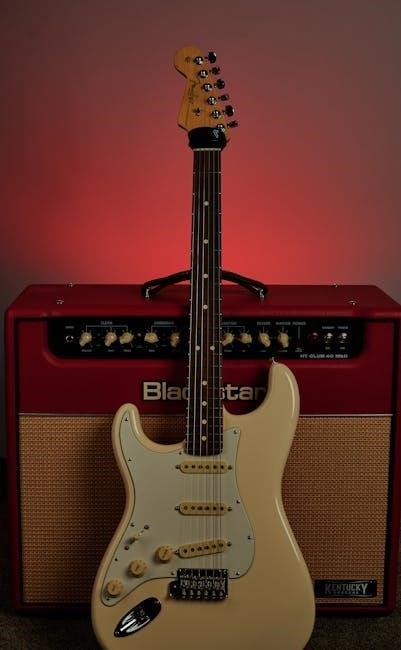
The BOSS Katana 50 MkII is equipped with a single 12-inch custom-designed speaker, engineered to deliver a wide frequency response and articulate sound. The manual emphasizes the speaker’s role in reproducing the amplifier’s diverse tonal palette, from clean and sparkling to high-gain distortion. The Katana-100 MkII and Katana-100/212 MkII models feature two 12-inch speakers for increased volume and a fuller sound. Proper speaker care, as outlined in the manual, ensures longevity and optimal performance.
Dimensions and Weight
The BOSS Katana 50 MkII’s compact design makes it suitable for various playing environments. The amplifier’s dimensions are approximately 470 mm (W) x 238 mm (D) x 308 mm (H), and it weighs around 11.2 kg. The manual stresses the importance of careful handling during transport, noting the folding leg attached to the bottom for stability. The Katana-100 models are larger and heavier, reflecting their increased power and speaker configuration, details found within the comprehensive user guide.

Leave a Reply
You must be logged in to post a comment.